
If you’ve not read (or re-read recently) George Orwell’s famous novel 1984 (or Nineteen Eighty-Four as the title was originally written), I’d strongly suggest taking it off the shelf and giving it a careful read, because the themes of that novel have never been so relevant to the current situation in our world as they are right now.
For a long time, people like me would point to 1984 in the context of state surveillance – citing concerns over increasing use of cameras, databases of personal information, and anything that helped the government keep track of where you were and what you were doing.
Recently, though, with the mechanisms of state surveillance firmly in place (and supplemented by “private” surveillance through tech companies and such), there’s been a shift towards the other side of the coin (as it were) – the enforcement of the will of the Party.
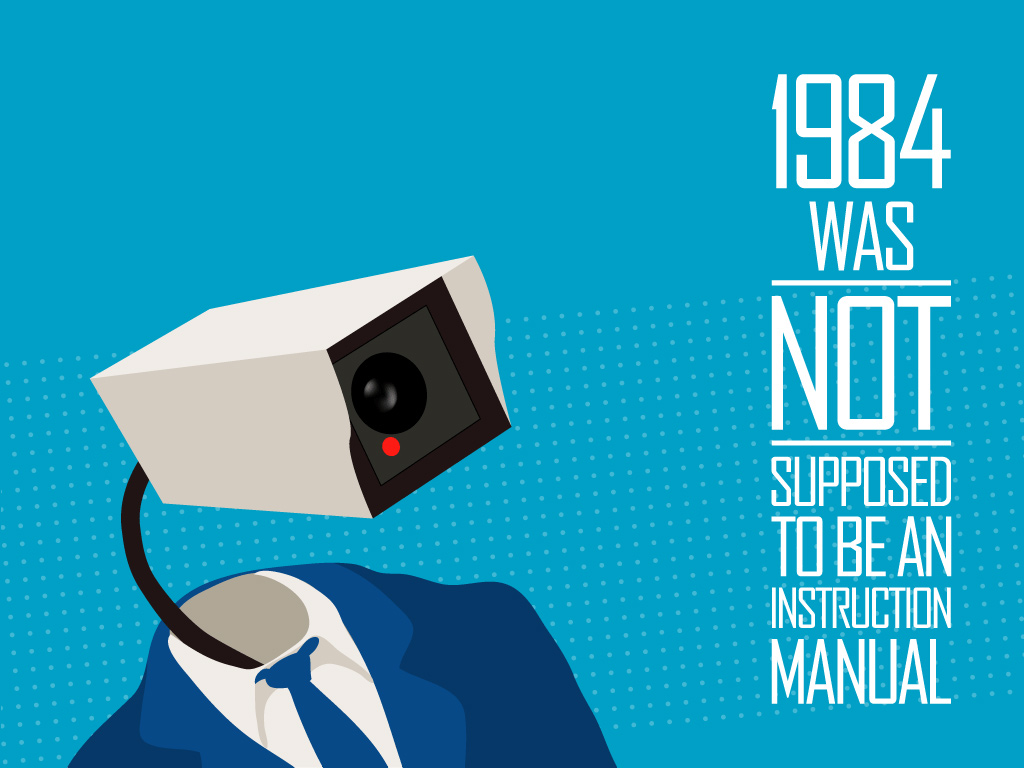
We’ve started seeing some things that honestly feel like they were ripped wholesale from the pages of 1984:
- A secret police/paramilitary force (our own “thought police” in the shape of ICE) being used against dissenters (protesters), taking people and disappearing them (making them “non-persons” by virtue of not being able to find or track them through the usual methods, moving them between prisons/facilities, and quietly shuffling them out of the country while denying ever having done so or being able to stop it once it’s done).
- Claiming that losses/defeats are actually victories (e.g. being rebuffed over Greenland, and then in the same breath turning around and claiming that you just negotiated a great deal).
- Significant use of what we can only call doublespeak – using the wrong words to refer to things you don’t like (e.g., calling protesters “insurrectionists” or “domestic terrorists, or referring to immigrants as “criminals”) to frame the narrative in the way that you want, or to distort the narrative to hide the truth, or to just outright lie and get away with it because of intentionally ambiguous or incorrect phrasing.
- Starting to see the beginnings of thoughtcrime, in treating certain concepts as so heretical and counter to the stance of the Party that the mere mention of them is subject to punishment – for example, topics like DEI or climate change.
- Something akin to the work of a Ministry of Truth in the form of re-writing historical records to align with the Party’s version of events and to always support the Party’s goals and principles as superior, and deleting from history anything that conflicts or doesn’t align with that.
- An “inner party” that has all of the power – in 1984 described as being less than 2% of the population; today we would call them “the 1%.”
- A continuous feed of state-sponsored (or state-influenced as we might say today) propaganda disguised as “news” – primarily today in the form of the big social media platforms (Twitter/X, Instagram, and TikTok) used to control what people hear about and influence what they believe. In a very real way, these social media platforms are the equivalent of the Telescreens of 1984 – they feed you what the state wants you to know, and they track what you do.
- A disturbing amount of very clear doublethink – people saying one thing while believing the other, or changing what they say they believe based on the circumstance or what the Party tells them to. The claim of “it was self defense” being the current equivalent to “we have always been at war with…”
I could go on and on – I could in fact probably create a list of almost every type of action the Party of 1984 took in that story and link it to some real-world action that has happened within the last year.
One thing that 1984 doesn’t do is tell us how, exactly, the world ended up in the state that is described in the book – we never get to see how the nation-states of Oceania, Eastasia, and Eurasia formed, or how the Party gained total control. However, given recent events I don’t think it’s hard to imagine anymore.
There is a line from 1984 – “until they become conscious, they will never rebel, and until after they have rebelled they cannot become conscious” – which is particularly applicable to today. It speaks to the commitment to the status quo, and the unwillingness to change, even when things are objectively terrible. We see this today in protest after protest, in horror and rejection of the violence of the state, and yet the voting patterns remain the same, the politicians call for change but do nothing, and the media cycle moves on to the next big thing. It is a particularly depressing thought – but only if you accept it as being true. Despite the modern-day similarities to the 3-tiered class structure of 1984 – the Inner Party (the 1%), the Outer Party (the wealthy upper-middle class), and the Proles (the 99%) – we have not quite reached that level of ignorance and irrelevance. While misinformation is rampant, the truth is still out there (for those who care to try and look for it).
There have been ample opportunities for us to stop this – plenty of times where we could have said “no,” or rolled back changes enacted in response to temporary emergencies. Things like the Patriot Act, REAL-ID, immigration reforms, and indeed the entire Department of Homeland Security itself were all created in reaction to single events, and whose purpose and useful lifetime have long since passed, yet they still persist.
Despite the late hour, there is still time to turn away from this disastrous path we are on – but that time is running out quick. If we don’t want to end up living in the world of 1984 (and to be clear, we do not), we must stop walking this path; we must stay conscious, and if necessary, we must rebel.

Likes
Reposts